Broad Match in 2026: Is It Finally Safe to Use — or Still a Budget Killer?
Broad match has a reputation. For years it was the match type PPC managers either avoided or heavily restricted — a source of irrelevant clicks, wasted spend, and unpredictable performance. In 2026, the question is whether that reputation still applies.
This article covers what broad match actually does today, how it differs from what it was, the conditions under which it works, and when it still remains a liability.
1. What Broad Match Does Today
Broad match allows Google to show your ad for searches related to your keyword — not just searches that contain it. The algorithm interprets the meaning and intent behind a query, not the literal words.
Example: Keyword: "running shoes". Broad match may trigger for: "best sneakers for marathon training," "trail footwear," or "jogging gear for beginners" — none of which contain the keyword.
In previous years, broad match was lexical — it matched synonyms and related terms with limited contextual awareness. Today the matching model uses machine learning signals including:
- User search history and browsing behavior
- Location and device context
- Landing page content of the advertiser
- Other keywords in the same ad group
- Real-time intent signals from the query
Keyword-based matching
Matched synonyms and related terms. Unpredictable. Required thousands of negative keywords to control. Frequently wasteful with no auction-time quality filter.
Intent-based matching
Uses AI to interpret user intent, context, and behavior signals. Pairs with Smart Bidding to filter by conversion likelihood at auction time — not just keyword relevance.
2. How It Changed — And What Actually Improved
The core improvement is the integration of broad match with Smart Bidding. Previously, broad match set bids the same regardless of query quality. Now, Smart Bidding evaluates every query at auction time and adjusts bids based on predicted conversion probability.
This means broad match no longer bids equally on a high-intent query and a low-intent one. The system suppresses bids on poor-fit searches and raises them on high-probability conversions — within the same campaign.
Additional changes affecting broad match behavior in 2026:
- AI Max for Search (launched May 2025): An evolution of broad match that adds creative flexibility and URL expansion. Uses the same intent-matching foundation.
- Phrase match has narrowed: Phrase match has become more restrictive over time, reducing its strategic value as a middle ground. Broad match now handles the discovery role more effectively.
- Account-level negative keyword lists: Now available natively in Google Ads, allowing exclusion themes to be applied across all campaigns without individual setup.
3. The Non-Negotiable Requirements
Broad match is not appropriate for all accounts or all campaign stages. The following conditions must be in place before using it.
Accurate conversion tracking is mandatory. Broad match paired with Smart Bidding optimizes toward whatever conversion action you define. If tracking measures low-quality signals (e.g., page views instead of purchases), the algorithm will scale toward those signals at full budget.
Smart Bidding is required. Broad match without Smart Bidding removes the auction-time quality filter. Without it, every query — regardless of intent — receives the same bid. This is how broad match historically burned budgets.
Negative keyword infrastructure must exist before launch. Broad match expands reach aggressively. Without a pre-built exclusion list, the first days expose you to irrelevant, costly traffic before you have data to diagnose it.
4. Match Type Comparison: Broad vs Phrase vs Exact in 2026
| Broad Match | Phrase Match | Exact Match | |
|---|---|---|---|
| Reach | Widest — intent-based | Moderate — phrase integrity required | Narrowest — query must match closely |
| Control | Low (offset by Smart Bidding) | Medium | High |
| Discovery ability | Strong | Limited | None |
| CPA predictability | Variable | Moderate | Most stable |
| Data requirements | 30–50 conversions/month | 15–30 conversions/month | Works at any volume |
| Negative keyword need | Critical | Moderate | Low |
| 2026 strategic role | Scale and discovery | Transitional — declining value | Brand & high-value queries |
| Recommended allocation | 60% (mature accounts) | 10% | 30% (brand + high-intent) |
5. When Broad Match Works
| Situation | Reason |
|---|---|
| Account has 30+ monthly conversions | Smart Bidding has sufficient data to distinguish high-intent from low-intent queries within broad match traffic. |
| Conversion tracking is accurate and tied to meaningful outcomes | The algorithm optimizes toward what you measure. Accurate tracking ensures it finds commercial intent, not just traffic. |
| Negative keyword lists are established before launch | Exclusion infrastructure limits exposure to irrelevant categories before they consume budget. |
| Goal is scale or query discovery | Broad match surfaces search queries that phrase and exact match miss entirely — including long-tail and conversational queries. |
| Campaigns have hit a volume ceiling on other match types | Adding broad match keywords re-opens the auction to new query segments without duplicating existing coverage. |
| Smart Bidding strategy is Target CPA or Target ROAS | These strategies apply the strongest auction-time quality filters to broad match traffic. |
6. When Broad Match Still Fails
| Situation | Why It Fails |
|---|---|
| Fewer than 30 conversions/month | Smart Bidding lacks data to identify which broad match queries convert. The algorithm defaults to volume over quality. |
| Conversion tracking measures shallow actions | If tracking fires on form views, time-on-site, or soft events, the algorithm scales toward cheap signals — not revenue. |
| No negative keyword list in place | Broad match explores aggressively. Without exclusions, budget is exposed to competitor terms, informational queries, and unrelated categories from day one. |
| Manual CPC bidding is used | Removes the auction-time quality filter entirely. Every query receives the same bid regardless of intent. |
| Ad group structure is disorganized | Broad match uses other keywords in the ad group as context signals. Mixed-intent ad groups reduce matching accuracy. |
| Lead quality is not tracked outside Google Ads | Platform metrics (CPA, conversion rate) can look strong while pipeline quality declines. Broad match can optimize toward easy-to-convert but low-quality leads. |
| Budget is under $2,000/month | At low budgets, broad match's exploration phase consumes a disproportionate share of spend before the algorithm stabilizes. |
7. Negative Keyword Strategy for Broad Match
Negative keywords are not optional with broad match — they are the primary control mechanism. The difference between profitable and wasteful broad match campaigns is largely determined by the depth and structure of the exclusion list.
Pre-launch exclusions (must exist before campaign goes live)
- Competitor brand names (unless deliberately targeting them)
- Informational intent modifiers: how, what, why, when, free, DIY, tutorial, guide, vs, meaning
- Employment modifiers: jobs, careers, salary, hiring, apply
- Non-commercial intent: review, Reddit, forum, complaint, lawsuit
- Price-sensitive qualifiers: cheap, discount, free, low cost (if not relevant to your offer)
Ongoing negative keyword management
- Review the Search Terms report weekly for the first month, bi-weekly after stabilization
- Add negatives at the account level using Account-Level Negative Keyword Lists to apply protection across all campaigns
- Avoid over-broad negatives that block legitimate long-tail queries — review each exclusion before adding
- Segment negatives by theme, not individual word — theme-based lists are easier to maintain and audit
8. How to Test Broad Match Safely
Do not add broad match keywords directly to existing campaigns without a controlled test. An uncontrolled rollout makes it impossible to measure impact and can destabilize well-performing campaigns.
- 1Use the Google Ads Experiment tool. Create a 50/50 experiment on an existing campaign. One variant uses current match types; the other introduces broad match. Run for a minimum of 4 weeks.
- 2Build the negative keyword list first. Before activating the experiment, ensure account-level and campaign-level negative keyword lists are in place.
- 3Verify conversion tracking before launch. Confirm the primary conversion action reflects commercial intent. Fix any tracking issues before the test begins.
- 4Use Target CPA or Target ROAS as the bidding strategy. These apply the strongest quality filters to broad match traffic. Maximize Conversions without a target is higher risk during a test.
- 5Monitor the Search Terms report weekly. Check which queries broad match is triggering. Add negatives for any irrelevant categories within the first two weeks.
- 6Evaluate on conversion volume, CPA, and lead quality — not clicks or impressions. Broad match will increase traffic. The question is whether that traffic converts at acceptable cost with acceptable quality.
- 7If results are positive, roll out gradually. Expand broad match campaign by campaign — not all at once — applying learnings from each rollout.
9. Verdict: Safe or Budget Killer?
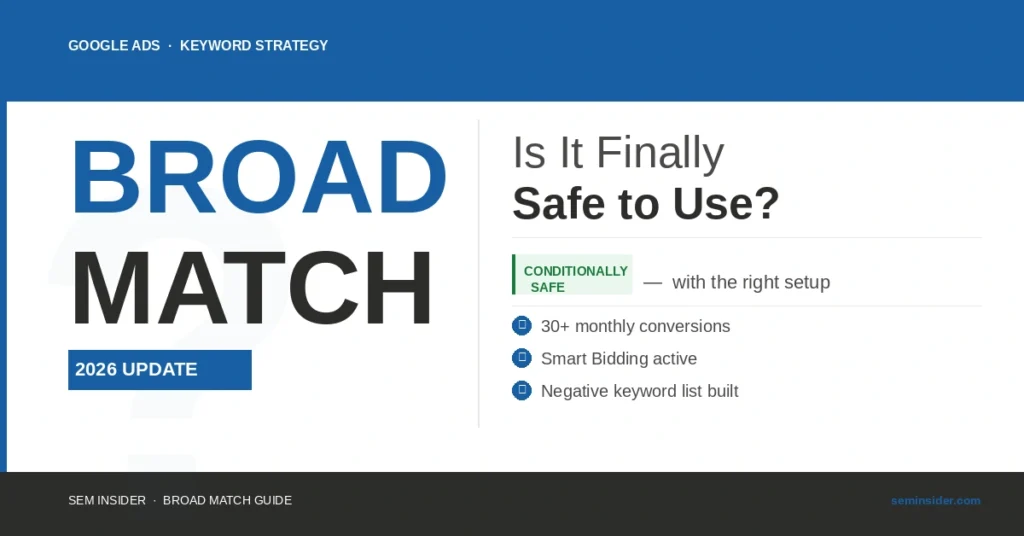
Broad match in 2026 is conditionally safe. The conditions that made it a budget killer — unpredictable matching, no auction-time quality filtering, no account-level negative infrastructure — have been addressed by the combination of AI-based intent matching and Smart Bidding.
Broad match is not a default setting for all accounts. It is a scaling tool for mature campaigns with sufficient conversion data, accurate tracking, and a robust negative keyword system.