If you got an email or in-account notification from Google about “changes to target-based bid strategies” and ignored it, go dig it out. This one is worth ten minutes of your time.
Here’s the short version. From August 17, 2026, campaigns that are limited by budget and running Target CPA or Target ROAS will start performing at the target you set. Not better than it. At it.
If you’ve been in Google Ads long enough, you already know why that sentence should make you a little nervous.
The behavior Google is killing
There’s an open secret in PPC. When a campaign has “Limited by budget” status, Smart Bidding can’t spend freely, so it becomes picky. It skips the expensive auctions and only shows up where a conversion looks cheap and likely.
The result? Budget-limited campaigns beat their targets. Often by a lot.
I see this constantly in audits. A campaign with a $10 Target CPA delivering at $5 or $6. A tROAS set at 300% returning 550%. And in almost every case, nobody set it up that way on purpose. Someone picked a target at launch two years ago, performance improved, and the target never got touched again because… why would you touch something that’s working?
Google is now saying this was never the intended behavior. Their reasoning is that it makes budget changes unpredictable. You raise the budget on one of these campaigns and suddenly the CPA jumps, and you have no idea why, because the efficiency was never coming from your target. It was coming from starvation.
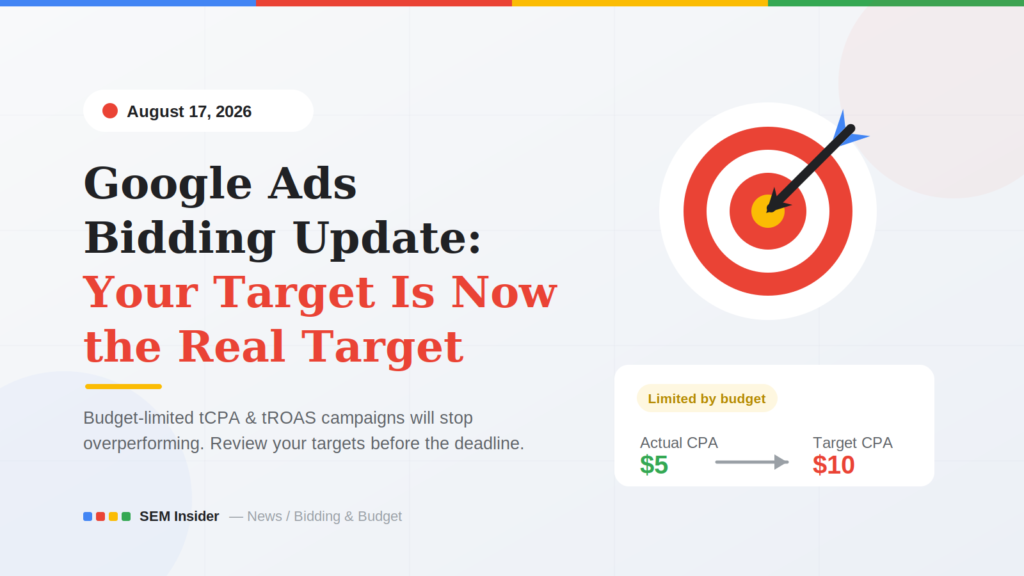
So from August 17, the system optimizes toward the number you actually entered, whether the budget is capped or not. Google’s own example, straight from the help doc: Target CPA of $10, recent actual CPA of $5. After the change, that campaign moves back toward a real $10 CPA. Unless you update the target yourself.
And no, Google will not update anything for you. They’ve been very clear about that.
Who needs to care
This covers Search, Shopping, Performance Max, and Demand Gen. Also Travel campaigns, plus campaigns managed through Search Ads 360, and Demand Gen in DV360. App campaigns and the Video reach/view formats keep the old behavior. Display and Hotel apparently already work the new way.
The trigger for notifications is broad, by the way. Any campaign that was budget-limited at some point in the last 12 months and uses one of these strategies. So if you manage an account that’s been on autopilot, expect to find campaigns in that list you forgot existed. I found two in a client account last week that had been “temporarily paused at reduced budget” since January.
PMax advertisers have an extra wrinkle. Because these are multi-channel campaigns, Google says traffic distribution across channels can shift too. A feed-heavy PMax that’s been living on Shopping placements might start spreading spend into YouTube and Display once it’s chasing your stated target instead of the cheapest possible path. Watch your channel-level reporting after the 17th.
And if you run a scaled ecommerce account: that target cushion has probably been baked into your margins for months without you knowing. Losing it in mid-August, right as Q4 planning starts, is bad timing. Don’t let it surprise you.
The tool is already in your account
Google released a Bid Target Adjustment Tool on July 6. It sits in campaign settings and shows your stated target next to actual historical performance for every affected campaign.
You get three options. Apply Google’s suggested update, which matches the target to recent performance. Enter your own number. Or leave it alone.
That third option is legitimate, by the way. If your target already reflects what your business actually needs, you don’t have to do anything, and after August 17 you can raise budgets and scale with more predictable results than before. That’s the genuine upside of this change, and it’s real. The problem is only for people whose targets stopped meaning anything years ago.
What I’d actually do this week
Not on August 16. This week. Updated campaigns need time to settle before enforcement kicks in, and Smart Bidding learning periods don’t care about your deadline.
First, pull every campaign that showed “Limited by budget” at any point in the last 90 days and check which ones run tCPA or tROAS. Don’t just filter for today’s status. Campaigns drift in and out of budget-limited depending on the season.
Then compare each target against real performance from the last 30 to 90 days. The bigger the gap, the higher the priority. A 500% tROAS setting on a campaign doing 900% is your first stop.
Now the actual decision, and this is the part most of the coverage I’ve read skips over. Ask yourself whether the over-performance was intentional. Some advertisers genuinely use tight budgets as an efficiency lever, knowing starvation forces the algorithm to cherry-pick. If that’s you, lower the target to match reality before the 17th and you keep your economics. But if the target just went stale, treat this as the strategy review you’ve been putting off. What CPA can your business actually afford? Maybe it really is $10 and the $5 was a bonus you can live without in exchange for volume. That’s a valid answer too. It just needs to be a decision, not a default.
Two more practical things. Write down your current CPCs, conversion volume, and cost per result before August 17. When numbers move in late August you’ll want a clean baseline, not memory. And don’t panic-judge the results in the first week. Google recommends waiting one to two full conversion cycles, especially if you have conversion lag. They’ve also warned that Performance Planner forecasts may be off between roughly August 17 and 31 while everything recalibrates, so don’t build Q4 budgets off a forecast pulled in that window.
Is this just Google raising prices?
That’s the accusation flying around, and I get it. A campaign that was converting at $5 will now happily spend up to $10 per conversion if that’s what your settings say. Multiply stale targets across a few million accounts and it smells like a revenue play.
Google’s Ads Liaison has pushed back hard on this, insisting the update won’t increase spend on its own and that the point is making the controls do what their names say: budgets control spend, targets control efficiency.
Honestly? Both sides are right. Mechanically, nothing about this change raises your costs. Practically, a passive advertiser with an outdated target will get worse efficiency at the same spend, and Google knows a large chunk of advertisers won’t act. The update rewards people who manage their accounts and taxes the ones who don’t.
Which, fine. That’s most Google Ads changes, if we’re being honest.
The bottom line: after August 17, your target stops being a loose suggestion the algorithm beats when it feels like it. It becomes the number you get. Go make sure it’s a number you actually chose.